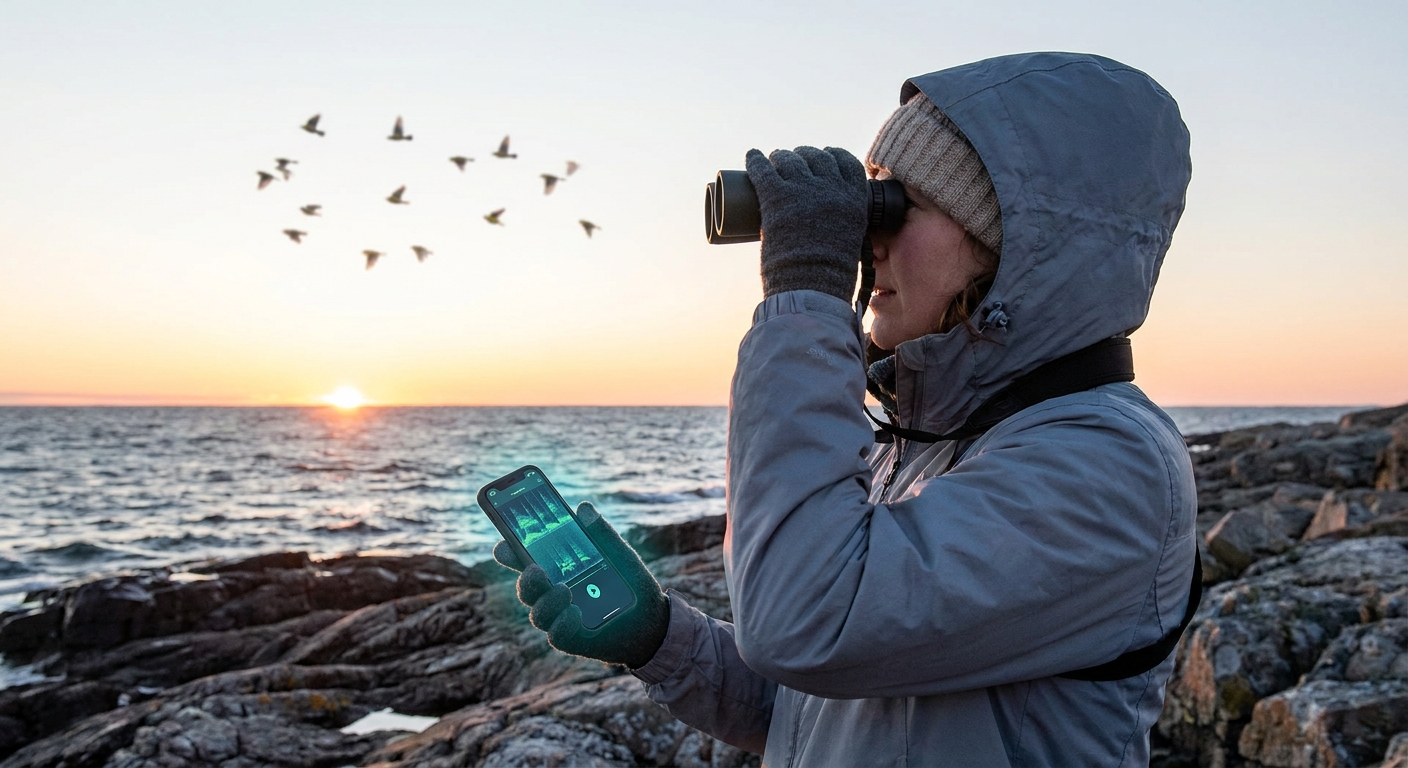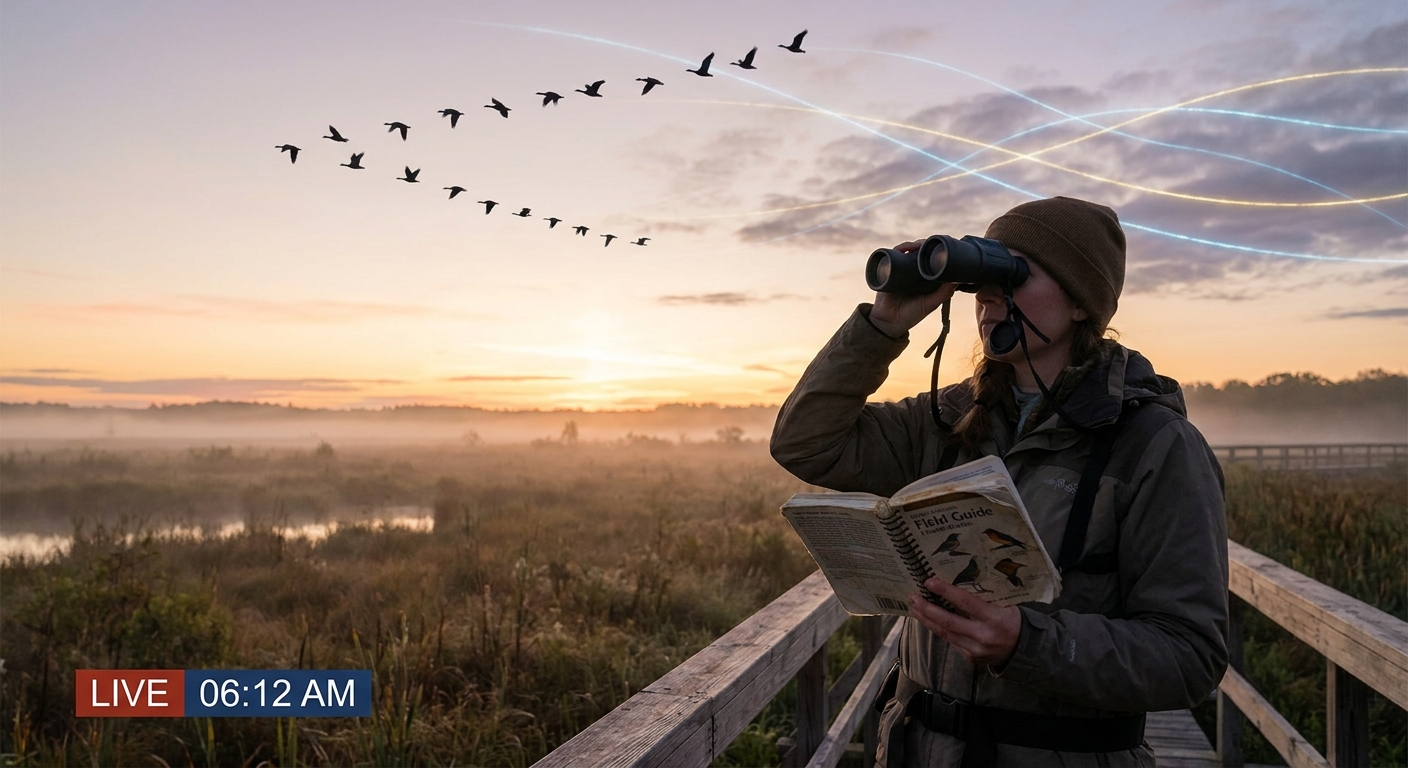
Every spring and fall, invisible rivers of birds flow overhead. Some follow coastlines, some trace mountain ridges, others cross continents and oceans in a single push. As birders, we tap into these migrations not with radar or satellite tags, but with binoculars, notebooks, and a habit of showing up.
Understanding the Skyroads Above You
This guide is meant to help you work migration: to anticipate it, recognize it, and make the most of it, whether you’re in a city park or a saltmarsh.
The Three Layers of Migration You Can Observe
Think of migration as three overlapping layers, all visible to an attentive birder.
1. High Flyers: Broad-front migrants
These species spread out across the landscape rather than concentrating in narrow corridors.
Common examples (North America / Eurasia analogues):
- Broad-winged Hawk / Honey Buzzard
- Canada Goose / Barnacle and Pink-footed Goose
- Common Crane / Sandhill Crane
- Altitude: Often very high, especially geese and cranes on clear days.
- Shape of flocks:
- Geese: loose or tidy V’s, sometimes double-V or wavering skeins.
- Cranes: ragged V or line, with dangling legs and slower, buoyant wingbeats.
- Sound:
- Geese: honking series, often loud and conversational.
- Cranes: loud, trumpeting or bugling calls that carry far.
- Clear weather after a period of poor conditions.
- Early morning and late afternoon when birds are lower and light is better.
What to look for:
Best conditions:
2. Highway Users: Leading-line migrants
These birds key in on geographic features—coastlines, rivers, ridges, island chains—to funnel movements.
Examples:
- Raptors using ridges and escarpments (e.g., Broad-winged Hawk, Honey Buzzard)
- Seabirds along coasts (Northern Gannet, shearwaters, jaegers/skuas)
- Swallows and martins following river valleys
- Ridges and escarpments:
- Look for raptors circling in thermals, then gliding off in a common direction.
- On cool, cloudy days, birds will be lower and closer; on warm sunny days, they ride higher thermals.
- Coastlines:
- Watch headlands and points that "stick out" into water—they act like funnels.
- Seabirds often pass in steady, directional lines. Track their movement parallel to shore.
- Rivers:
- Bridges and exposed sandbars make good vantage points for watching swallows, kingfishers, and shorebirds.
Field tips:
3. Ground-level Drifters: Nocturnal and stopover migrants
Most songbirds migrate at night and drop into habitats to rest and feed by dawn. This is where careful fieldcraft pays off.
Examples:
- Warblers, vireos, thrushes, flycatchers
- Many sparrows and buntings
- Suddenly "birdy" hedgerows in a place that was quiet a few days before.
- Mixed-species flocks moving restlessly through the canopy.
- High, thin seep and tsee calls at dawn from overhead or high in trees.
- The highest, leafiest tree in a small park—often a magnet.
- Edges: where tall trees meet shrubs, or shrubs meet open ground.
- Sunlit sides of trees early in the morning, where insects warm up first.
Tell-tale signs of a good migrant morning:
Where to look:
Seasonal Context: Timing Is a Field Mark
Timelines vary by region, but migration follows a pattern within each area. Knowing that pattern can narrow your ID list before you even raise your binoculars.
Spring Migration
- Early spring (late Feb–March in temperate zones):
- Geese, ducks, early shorebirds, blackbirds, larks.
- Species ID often focuses on flock shape and sound—light can be harsh, foliage is sparse.
- Mid–late spring:
- Warblers, flycatchers, orioles, cuckoos.
- Trees leaf out just as peak diversity hits: you’ll need ear-birding and patience.
Fall Migration
- Longer, slower, often richer in numbers.
- Juveniles everywhere: field marks can be duller, patterns more subtle.
- Shorebirds: often best in late summer into early fall.
- Raptors: build toward concentrated movements along ridges and coasts.
Tip: Keep a simple, date-ordered list for your local patch. Over a couple of years you’ll build your own hyperlocal migration calendar.
Identification Tips by Group During Migration
Warblers and Other Tiny Passerines
Behavioral clues:
- Warblers are "fussy"—nervous movements, constant hopping and picking.
- Flycatchers sally out from perches to grab insects, then return.
- Start with structure: length of tail, bill thickness, overall posture.
- Use light: position yourself so the bird is between you and the sun; backlighting kills color but reveals shape.
- Note the face pattern first: eyering vs. eyeline, supercilium (eyebrow), and throat color often stick in memory better than subtle body tones.
Field strategies:
Shorebirds on the Move
During migration, many shorebirds are in transitional or juvenile plumage, which can be confusing. Focus on:
- Size next to familiar species. A Lesser Yellowlegs beside a Greater Yellowlegs is a textbook lesson.
- Leg length and bill length relative to head. Is the bill shorter than, equal to, or longer than the head? Straight or slightly drooped?
- Feeding style:
- Plovers: pause-run-peck.
- Sandpipers: more continuous picking or probing.
Raptors Riding the Thermals
At migration lookouts, you often see raptors at a distance. Learn silhouette first:
- Accipiters (e.g., Sharp-shinned, Eurasian Sparrowhawk): short wings, long tail; flap-flap-glide rhythm.
- Buteos (e.g., Red-tailed Hawk, Common Buzzard): broad wings, wide tail; more soaring, less flapping.
- Falcons (e.g., Kestrel, Peregrine): long, pointed wings, narrow tail; powerful, direct flight.
Watch multiple birds at once: comparisons make ID easier than isolating a single distant hawk.
Gear and Techniques for Working Migration
Core Gear
- Binoculars (8x or 10x):
- 8x gives a wider field of view, great for tracking moving flocks.
- 10x pulls in distant raptors and shorebirds but demands a steadier hand.
- Field guide or app:
- Choose one with good plates for juveniles and nonbreeding plumages.
- Range maps with migration timing will help filter possibilities.
- Notebook or notes app:
- Record weather, date, and general movement. Over time, you’ll spot patterns.
Helpful Extras
- Spotting scope: invaluable for shorebirds, waterfowl, and distant raptor kettles.
- Headlamp with red light: for pre-dawn starts; red light spooks birds less and preserves your night vision.
- Voice recorder or phone: to capture nocturnal flight calls or quick notes.
Tactical Birding: How to Position Yourself
Read the Weather
Migration doesn’t move at a steady trickle; it pulses.
- Spring:
- Strong tailwinds and clear skies after a period of bad weather trigger big pushes.
- Following dawn can be spectacular for ground-level migrants.
- Fall:
- Cold fronts followed by clear, calm nights often produce heavy nocturnal movement.
Work the Edges and Funnels
On a migration morning at a random park, don’t wander aimlessly. Instead:
- Start at the highest vantage point you can reach—scan sky and tree tops.
- Walk the downwind edge of stands of trees; insects (and thus migrants) often concentrate there.
- Check any water feature thoroughly: ponds, creeks, even drainage ditches can pull in tired birds.
Learn to Listen Up
Even if you’re not confident with bird song, you can make use of migration sounds:
- Nocturnal flight calls (NFCs):
- High, single-note calls overhead at night or just before dawn.
- Even if you can’t ID them, noticing their presence tells you a movement is happening.
- Dawn chorus during migration:
- Mixed voices, often less full than breeding-season song.
- Listen for unfamiliar chips and seets between resident species.
Vivid Field Notes: Recording What the Sky Tells You
Migrants reward close noting of context. When you write observations, capture:
- Where: ridge, park, coast, city block.
- When: date, time, and light conditions.
- How many and how: small loose flock, tight V, steady stream, waves.
- Direction of movement: note it in compass terms if you can (e.g., "steady NE passage").
Example Field Note
7 May, 06:15–08:00, city park. Clear, light NW wind. Strong movement: at least 60 warblers in mixed flocks, mostly in upper canopy on east side of park catching first sun. Dominant species Yellow-rumped and Black-throated Green; several bright male Blackburnians. Constant overhead seep calls at dawn tapered by 07:30.
Such notes turn your local patch into a long-running migration story.
The Reward of Learning the Invisible Rivers
Migration is both predictable and surprising. The more you learn the routes, timing, and behavior of migrants, the less random your birding will feel. With each season, flocks that once rushed past as anonymous shapes become identifiable travelers following routes you can anticipate.
Bring curiosity, patience, and a willingness to jot down what you see. The skyroads are there every year; our job is simply to pay attention.