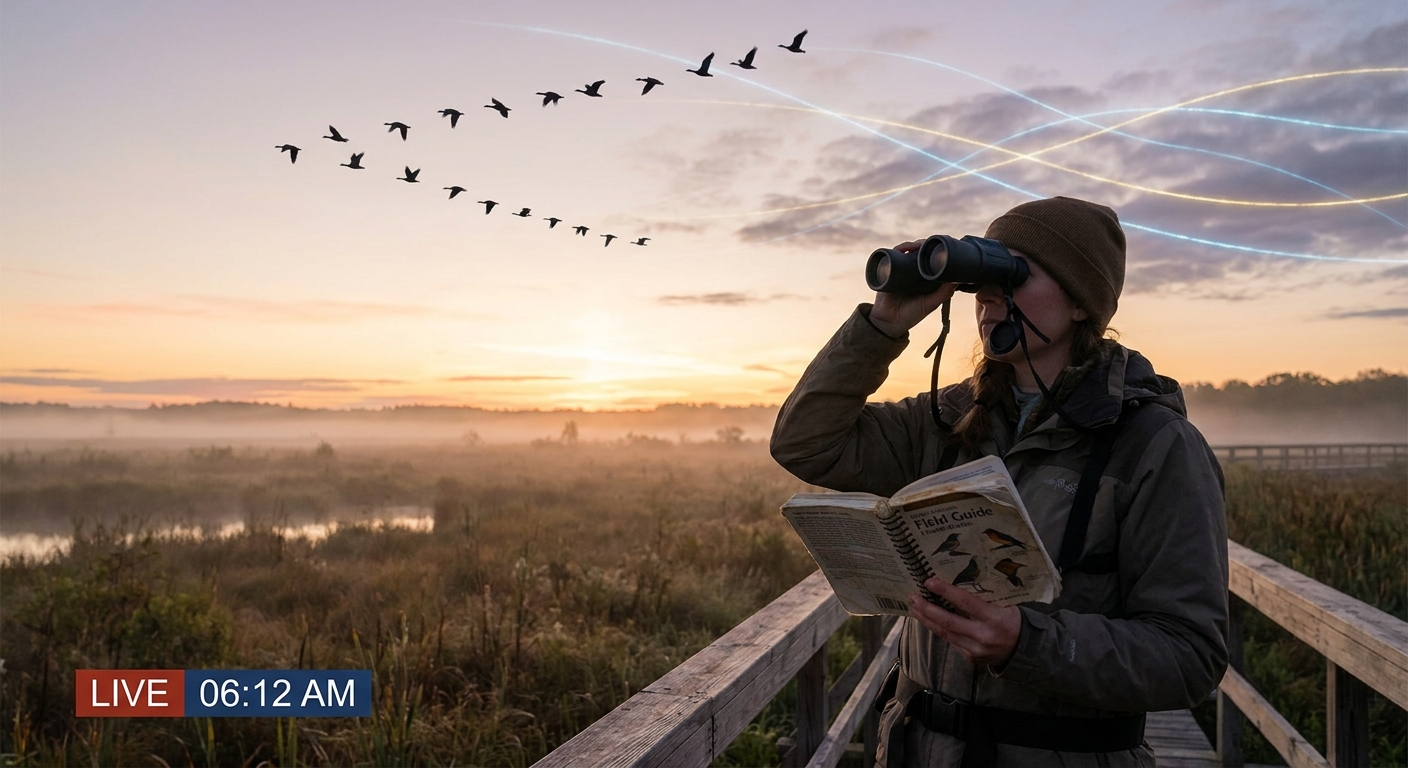
Migration is when familiar places suddenly feel new. A grocery-store parking lot hedgerow can hold a gem; a quiet city rooftop becomes a listening post for invisible travelers. This article is a tactics manual: specific, field-tested ways to experience migration more fully, whether you have ten minutes before work or a full day at the coast.
Why Migration Is the Birder’s Secret Season
We’ll move through the day—night to afternoon—and across habitats, layering in species ID tips, gear suggestions, and field notes you can adapt.
Night: Listening to the Dark
Most small songbirds migrate at night, high overhead. You may not see them, but you can still witness their passage.
Nocturnal Flight Calls (NFCs)
As they travel, many species give short "contact" calls. With a little practice you can learn to recognize patterns, but even before that, just noticing that birds are passing is powerful.
How to start:
- Pick a safe, relatively quiet spot: backyard, balcony, rooftop, park edge.
- Step outside for 5–10 minutes on clear, mild nights during peak migration (often a few hours after sunset).
- Stand quietly and listen for high, thin peeps, seets, or chips from overhead.
- Ears first. No equipment required.
- Optional: use a smartphone voice recorder pointed at the sky; you can review later or compare with online NFC libraries.
Simple gear:
Field note example:
23 September, 22:15–22:25, apartment roof. Light south wind, partly cloudy. Heard at least a dozen thin, upward "tsee" calls and several sharper chip notes overhead—steady but not heavy passage.
You may not know the species yet, but this tells you something else: the next morning could be excellent.
Dawn: Working the First Light Window
The hour around sunrise is prime time for ground-level migrants that have dropped in to rest and feed.
Choosing a Dawn Spot
You don’t need a famous hotspot. Look for:
- A cluster of mature trees in an otherwise open area.
- Any water: pond, creek, even a stormwater basin.
- Edge habitat: where tall trees, shrubs, and open ground meet.
How to Scan Effectively
- Start high.
- Scan treetops silhouetted against the brightening sky.
- Look for flickers of movement hopping from branch to branch.
- Follow the sun.
- Birds often feed first on the sunlit side of trees.
- Position yourself so you’re not staring into the sun, but can see its light on the foliage.
- Listen for chips and seets.
- Even without knowing species, you’ll hear a restless layer of soft contact calls when migrants are present.
Species ID Shortcuts for Morning Migrants
Focus on structure and behavior rather than fine color details.
Small insectivores (warblers, kinglets, vireos):
- Constant motion, working twigs and leaf undersides.
- Kinglets: tiny, hyperactive; often flick wings. Ruby-crowned/Goldcrest show bold face patterns and may hover briefly.
- Vireos: move more methodically, thicker bills, often maintain a slow patrol along branches.
- More ground- and mid-level.
- Upright stance, often pausing to look around.
- Soft "whit" or "tchuk" calls from understory and edge.
- Does the bird show two bold white wingbars? (Think many "confusing fall warblers" or some buntings.)
- Is there an obvious eyestripe or full eyering?
- Are the undertail coverts (feathers under the tail) contrasting in color with the belly or back?
Thrushes:
Quick ID cues:
Write down or voice-record these impressions immediately. The act of describing cements the observation.
Mid-Morning: When Raptors Take to the Air
As the air warms, thermals form and raptors begin to move. You don’t need a famous hawk watch site to see this; even suburban areas can host a daily passage during peak weeks.
Reading the Sky
Where to look:
- Above ridgelines, cliffs, or any topographic high point.
- Over open fields or large parking lots that heat up quickly.
- Birds circling upward in loose groups ("kettles").
- Individuals gliding on straight or gently curving paths between thermals.
What you’ll see:
Simple Silhouette Tactics
When birds are high, think "how is this bird shaped and how does it move?"
- Accipiters (Sharp-shinned/Cooper’s / Sparrowhawk):
- Long tail, relatively short wings, sometimes described as "flying cross" shape.
- Erratic flap-flap-glide routine.
- Buteos (Red-tailed / Buzzard types):
- Broad, wide wings and relatively wide tail.
- Soar for long periods without flapping much.
- Falcons:
- Pointed wings, narrow tail.
- Direct, rapid flight; can be very fast in level flight.
Don’t worry about naming every distant speck. Start by sorting shapes into these buckets.
Gear Tips for Raptor Watching
- Binoculars: 8x binoculars are ideal for a wider field; 10x if birds are consistently high and you’re comfortable holding them steady.
- Hat and sunglasses: Eye protection is as important as optics when you’re staring skyward.
- Notebook: Keep a simple tally: species, rough numbers, direction of movement, and notable weather.
Midday: Shoreline and Wetland Surprises
As songbird activity dips late morning, wetlands and shorelines often come into their own.
Finding Migrant Shorebirds and Waterfowl
Even small water features can act as emergency rest stops:
- Flooded fields and puddles left by heavy rain.
- Exposed mud around shrinking ponds.
- Urban retention basins with a bit of shoreline.
Shorebird ID in Migration Conditions
Nonbreeding and juvenile plumages can be tricky, so emphasize:
Size comparisons:
- Use a familiar species (Killdeer, Common Sandpiper, Lapwing, local gulls) as a measuring stick.
Leg and bill structure:
- Are the legs obviously long relative to body (yellowlegs / greenshanks) or short (plovers)? - Is the bill straight or gently downcurved? Very short, medium, or very long?
Feeding style:
- Plovers: stop-start motion—short runs, abrupt stops, then a quick peck. - Sandpipers/Stints: more continuous picking or probing, often head-down.
Waterfowl on the Move
During migration, mixed flocks of ducks can hold surprises.
Tactics:
- Start broad: separate dabblers (feeding on surface, tails up) from divers (disappear underwater after steep dives).
- Look for odd shapes/colors: a slightly different head shape or flank pattern in a mass of common species can signal a rarity.
- Check edges and loafing areas: tired or wary birds often keep a little distance from dense, noisy flocks.
Afternoon: Working Urban and Suburban Green Patches
By afternoon, light is harsher and bird activity can seem slow—but migration can still be read.
Micro-habitats That Pay Off
In cities or suburbs, focus on:
- Single tall trees or small groves that stick up above surrounding buildings.
- Fruit-bearing trees and shrubs (mulberry, elder, hawthorn, ornamental crabapple).
- Rain gardens or low spots where water collects.
Technique: Slow Down and Circle
Rather than walking quickly through a park:
- Pick one promising corner—say, a line of trees along a pond.
- Spend 10–15 minutes simply watching.
- Slowly circle the patch, changing your angle relative to the sun.
You’ll often notice birds you would have missed with a brisk pass. Migrants can sit quietly for long stretches before a burst of activity.
Species to Expect
- Flycatchers: on exposed perches, making short sallies for insects.
- Warblers and small passerines: using shady side branches in heat.
- Swallows and swifts: feeding over fields, parking lots, and playing fields.
ID tip: Watch a single bird for as long as you can. Note one clear feature—face pattern, tail shape, or call—and write that down. You can match it later at home.
Adapting Your Gear to Migration Days
You don’t need to carry everything, every time. Pack for the specific migration phase you’re targeting.
Lightweight Dawn Kit
- Binoculars
- Compact field guide or app
- Small notebook or phone notes app
- Thin gloves and beanie in cooler seasons
Raptor and Shorebird Kit
- Binoculars
- Spotting scope + tripod (if available)
- Hat, sunglasses, sunscreen
- Extra layers—exposed viewpoints can be windy
Night Listening Kit
- Just yourself and perhaps a small audio recorder
- Dim or red-filtered flashlight for moving around safely without ruining night vision
Keep a small dry bag pre-packed with your core birding items so that when the forecast and migration reports look good, you can head out quickly.
Using Weather to Predict Your Best Days
Migration is tightly tied to weather. A few simple rules can dramatically improve your odds.
Spring Rules of Thumb
- After two or more nights of poor conditions (strong headwinds, rain), watch for:
- First clear night with light tailwinds: big push of migrants.
- Following morning: high diversity in small patches of habitat.
- Warm fronts can lift insect numbers, drawing in insectivores like warblers and flycatchers.
Fall Rules of Thumb
- Cold fronts followed by clear, calm nights often bring major movements.
- The first crisp night after a muggy spell can trigger sharp changes overnight.
Combine simple weather awareness with your own records. Over a couple of seasons, you’ll be able to say things like: "The third week of September plus a northwest wind? That’s when the thrushes move through my park."
Building Your Own Migration Logbook
To make migration knowledge "stick" to your local area, keep a dedicated log. It doesn’t have to be fancy.
What to Record
For each outing, note:
- Date, time, and location.
- Weather: temperature feel, wind direction, cloud cover, any precipitation.
- General movement:
- Overhead: any visible flocks or steady passages?
- On the ground: sudden appearance of certain groups (warblers, sparrows, shorebirds)?
- A short species list with rough counts or abundance codes (common, few, single).
A Sample Entry
3 October, 06:45–09:00, Riverside Park. Cool, clear, light NW wind. Noticeable increase in sparrows at weedy field edge (White-throated, Song, a few Lincoln’s). Several mixed warbler flocks still present but numbers down from last week. Overhead: light but steady stream of high, loose flocks of blackbirds heading south.
Over years, these notes become a personal migration field guide tailored to your exact patch.
Let Migration Change How You See Familiar Places
Migration isn’t a separate event from everyday birding; it’s a pattern woven through it. By tuning into night calls, dawn flocks, raptor thermals, and shoreline changes, you start to see that pattern clearly.
You don’t need perfect ID skills or exotic locations. Show up often, pay attention to weather and behavior, and record what you find. The real magic of migration is not just in rare birds—it’s in recognizing that even your most ordinary haunts sit on a dynamic aerial highway that pulses, twice a year, with life on the move.