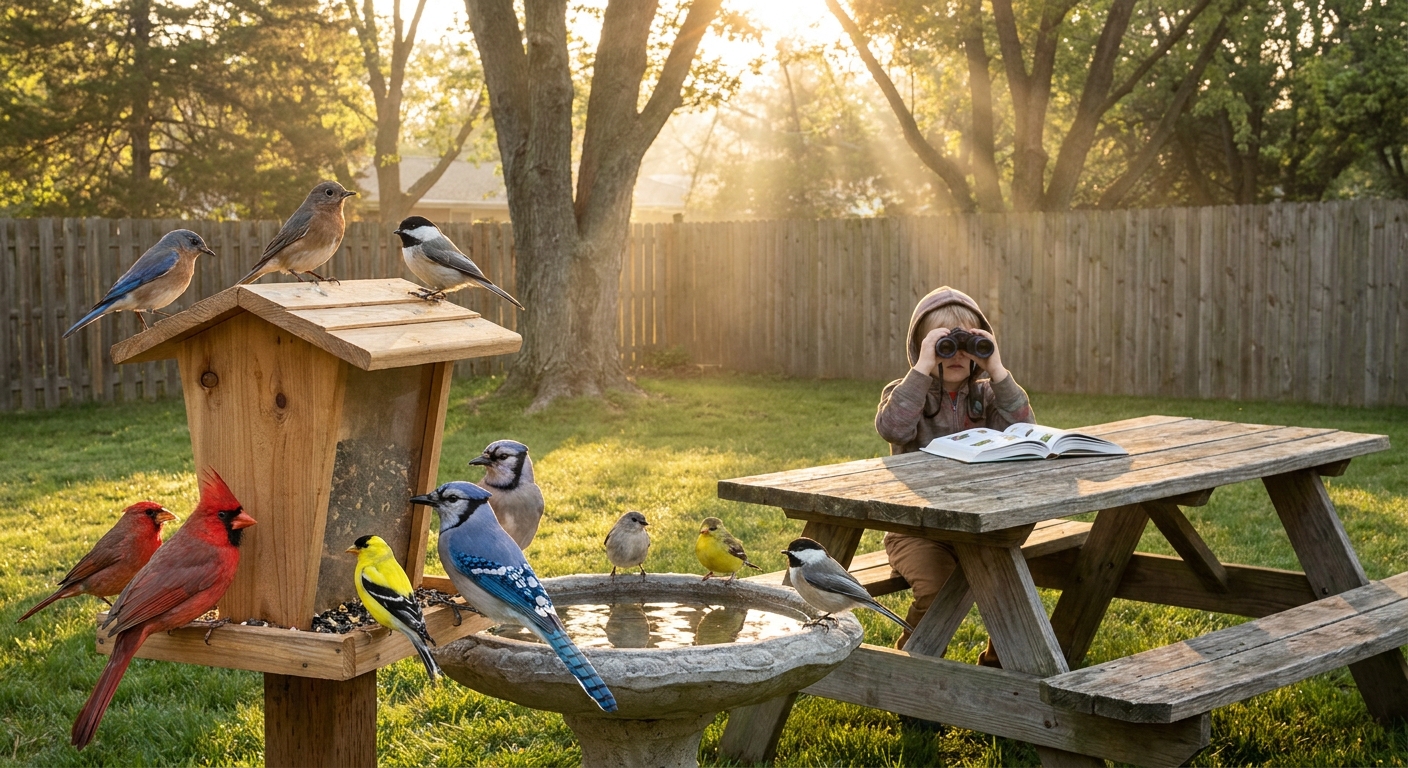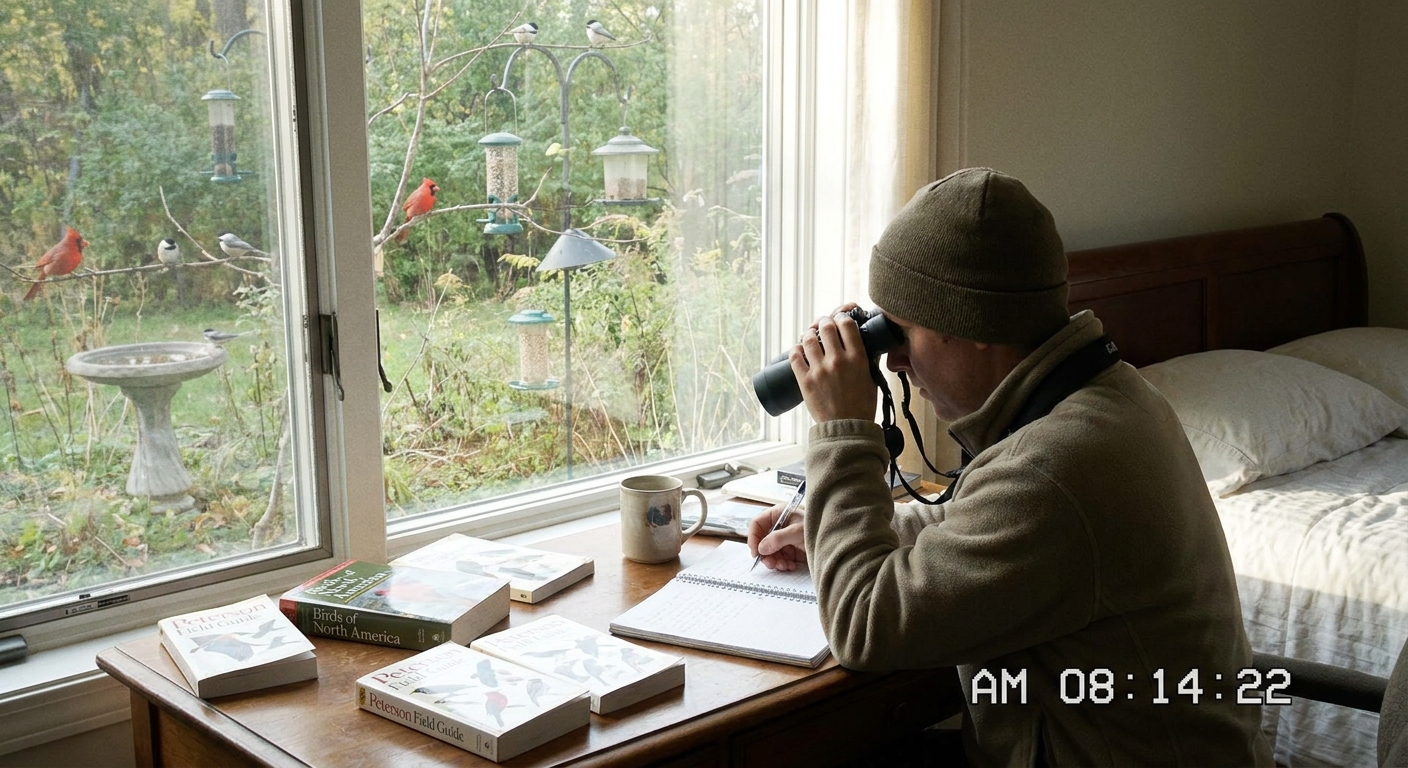
You don’t need a vast forest or a remote wetland to practice real field ornithology. A balcony, modest yard, or shared courtyard can become a living study plot—one you can visit daily, in all seasons, and in all kinds of light and weather.
Why Your Backyard Is a Perfect Bird Lab
By treating your outdoor space as a mini observatory, you can refine identification skills, learn bird behavior in depth, and contribute useful data, even if you never leave the block.
This guide walks through how to set up, observe, and record backyard birds like a field biologist, with practical tips for every experience level.
Step 1: Read Your Habitat Like a Map
Before you think about feeders, start with the habitat that already exists. Your birds do.
1.1 Vertical Layers
Walk the perimeter of your space and note habitat "layers":
- Ground layer: Lawn, bare soil, mulch, leaf litter, pavement. Good for: robins, sparrows, juncos, towhees, doves.
- Shrub layer (0–8 ft): Hedges, bushes, low saplings. Good for: cardinals, wrens, chickadees, sparrows.
- Mid-canopy (8–25 ft): Small trees, fruiting ornamentals. Good for: finches, orioles, mockingbirds, woodpeckers.
- Canopy and sky: Tall trees, wires, rooftops, open airspace. Good for: jays, crows, swallows, raptors.
As you watch birds move through these layers, you’ll start to associate species with preferred heights—an underused but powerful ID clue.
1.2 Edge Effects
Birds love edges: where lawn meets shrubs, where trees fringe a parking lot, where a fence borders a field. If your yard is mostly open, notice even small edges like an overgrown corner or a single, untrimmed shrub—these become high-traffic spots.
Mark these on a rough sketch map. You’ll return to this map often.
Step 2: Choose Gear That Makes Observation Easy
You don’t need specialized equipment, but a few tools can dramatically improve what you see.
2.1 Binoculars
- Magnification: 8× is ideal for backyard work—wide field of view and steady image.
- Objective size: 32–42 mm provides good brightness for dawn and dusk.
- Comfort test: If they feel heavy after five minutes, you’ll use them less. A comfortable, mid-range pair gets more field time than a bulky premium model.
Keep them on a hook by the door or window where birds are most visible.
2.2 Field Notebook or App
- Notebook: Any pocket notebook works. Dedicate one to your yard. Date each page and list species, counts, and notable behavior.
- Apps: eBird, Merlin, and similar tools can help track lists and provide ID support, but writing by hand often makes you observe more closely.
2.3 Optional Enhancements
- Spotting scope: Helpful if your yard is large or birds stay at the far fence line.
- Camera: Even a phone camera through binoculars (digiscoping) can provide ID evidence for later study.
Step 3: Build a Simple, Bird-Friendly Setup
You can attract birds without turning your yard into a feeder farm. Focus on three essentials: food, water, and cover.
3.1 Food: Feeders with Purpose
Start small and observe how birds respond.
- Black oil sunflower seeds: A universal favorite for cardinals, chickadees, woodpeckers, finches, and many others.
- Nyjer (thistle) seed: Specialized feeder for goldfinches, siskins.
- Suet: Excellent in cooler months for woodpeckers, nuthatches, creepers, wrens.
Use quality feeders that are easy to clean. A dirty feeder is a health hazard; plan a quick scrub every 1–2 weeks with hot, soapy water.
Observation reward: Different feeders attract distinct feeding behaviors. Watch chickadees grab a seed and retreat, cardinals perched steadily while cracking shells, and woodpeckers clinging vertically.
3.2 Water: The Universal Magnet
A simple birdbath may draw more species than any single food source.
- Depth: Keep water shallow (1–2 inches) or use stones to create varying depths.
- Movement: Drippers, bubblers, or a small solar fountain add sound and flash that catch passing birds’ attention.
- Hygiene: Refresh every 1–3 days, more often in hot weather.
Observe not just who drinks, but how: robins wading in, finches bathing tentatively at the edge, jays monopolizing the bath for exuberant splashing.
3.3 Cover: Safety and Nesting
Birds are more likely to visit if they can retreat quickly.
- Add a dense shrub or allow part of a hedge to grow thicker.
- Stack brush piles or fallen branches in a quiet corner for wrens and sparrows.
- Leave some leaf litter for ground-feeding and insect-hunting species.
Avoid placing feeders or baths out in the open far from cover; birds must cross exposed space that favors predators.
Step 4: Learn to ID by Structure, Not Just Color
Field guides emphasize color, but light and distance often wash that away. Train yourself to read shape, posture, and movement.
4.1 Silhouette and Proportions
When you see an unfamiliar bird, ask:
- Head vs. body: Big-headed (like chickadee) or sleek (like robin)?
- Tail length: Short and stubby (starling) or long and pointed (Mourning Dove)?
- Bill shape: Thick cone (finch, sparrow), straight chisel (woodpecker), slender and pointed (warbler, kinglet).
Practice with familiar species:
- Watch a House Finch and sketch its outline, ignoring color.
- Compare that with a House Sparrow: note the squarer head and slightly different bill.
4.2 Movement Signatures
Each species group has a typical movement style:
- Thrushes (e.g., American Robin): Run-stop-run on lawns.
- Sparrows and towhees: Hop, often double-footed, scratching leaf litter.
- Finches: Bounce in flight, with undulating up-and-down patterns.
- Woodpeckers: Hitch up trunks in short, jerky steps, often using their tail as a prop.
Observe with binoculars lowered first. Notice how a bird uses your yard as a three-dimensional space.
Step 5: Use Your Ears as Much as Your Eyes
Backyard birding quickly becomes richer when you learn a few core calls and songs.
5.1 Build a "Yard Sound Palette"
Spend a few minutes each morning just listening.
Common yard voices to learn (names may vary regionally):
- Chickadee: “chick-a-dee-dee-dee” (scold) and whistled “fee-bee” (song for some species).
- Tufted Titmouse: Clear, repeated “peter-peter-peter.”
- Northern Cardinal: Loud whistles like “cheer, cheer, birdy-birdy-birdy.”
- Downy Woodpecker: Short, sharp “pik!” call.
- Blue Jay: Harsh "jay" calls plus a variety of whistles and imitations.
Record clips on your phone and label them after checking a trusted app or guide. Over time, you’ll "see" birds by ear before your binoculars ever find them.
5.2 Note Context
When you hear a call, watch what the bird is doing:
- Alarm calls when cats appear.
- Flocking contact calls when small birds travel together.
- Soft begging calls from fledglings in late spring.
This kind of context-aware listening turns basic ID into behavioral understanding.
Step 6: Keep a Yard List Like a Field Researcher
6.1 The Core Data
On each observation day, record:
- Date and time
- Weather (temperature, cloud cover, wind)
- Species list with approximate counts
- Notable behaviors (courtship, feeding, nesting, aggression)
Example entry:
7 April, 7:10–7:30 a.m., overcast, cool.
3 American Robins (2♂, 1♀) feeding on lawn; 1 carrying worms toward hedge.
2 Northern Cardinals (pair) visiting feeder, male singing from maple.
1 Downy Woodpecker (♂) at suet, chased briefly by starling.
6.2 Seasonal Patterns
After a few months, review your notes.
Look for:
- First appearance dates of migrants (e.g., White-throated Sparrow in fall).
- Peak numbers of certain species.
- Changes in behavior: when songs begin, when fledglings appear, when flocking increases.
You’re now doing long-term monitoring—something many formal studies lack at such a fine scale.
Step 7: Ethical and Safe Backyard Birding
Your observatory should be safe for birds as well as informative for you.
7.1 Window Strikes
Glass reflections can be deadly. Reduce risk by:
- Placing feeders either within 3 feet of windows (birds can’t build up speed) or farther than 30 feet.
- Adding window decals, cords, or external screens where collisions occur.
- Slightly tilting birdbaths or shiny surfaces to reduce sky reflections.
7.2 Predator Awareness
- Keep cats indoors or supervised; roaming cats are a major cause of bird mortality.
- Avoid creating ambush spots (e.g., low shrubs) directly under feeders; keep some open visibility.
7.3 Feeder Hygiene
- Clean feeders and baths regularly.
- Remove wet, moldy seed immediately.
- During any reported disease outbreaks (finch eye disease, salmonella events), consider taking feeders down temporarily and rely on natural food sources.
Species to Watch for in a Typical Backyard
Every region differs, but many backyards in temperate North America can expect:
- Year-round residents: Black-capped/Carolina Chickadee, Downy Woodpecker, Northern Cardinal, Blue Jay, House Sparrow, House Finch, Mourning Dove.
- Winter visitors: Dark-eyed Junco, White-throated Sparrow, American Tree Sparrow (more northern), various finches in irruption years.
- Summer breeders: American Robin, Gray Catbird, Common Grackle, Barn Swallow (if fields and outbuildings nearby), various warblers passing through.
- Flyovers: Hawks catching thermals, migrating geese, high-flying swifts and swallows.
Keep a separate section in your notebook for surprises—those one-time visitors that appear during migration or after storms.
Making Every Visit Count
The magic of a backyard observatory is repetition. The same patch of sky, the same fence line, the same maple tree—all seen in hundreds of different moods, seasons, and bird combinations.
Over time you’ll:
- Recognize individual birds by subtle plumage wear or behavior.
- Predict when certain species will appear (first robin song, first goldfinch molt).
- Notice interspecies dynamics—who yields at feeders, who dominates baths, who sounds the alarm.
What begins as casual glances out a window can become a deeply informed relationship with a very small piece of the world. That intimacy—with place, with season, with feather and flight—is the essence of good field work.
And you can practice it every day, just a step or two from your door.