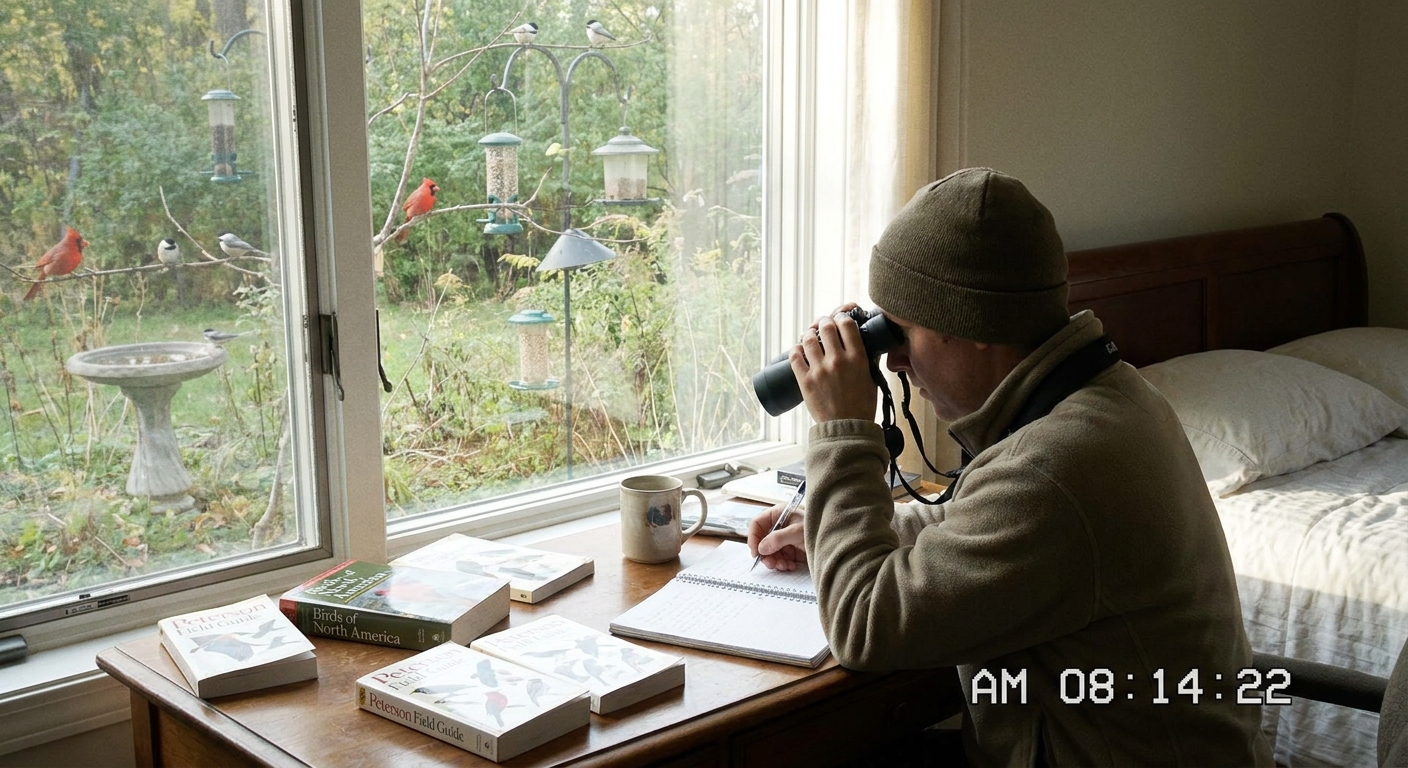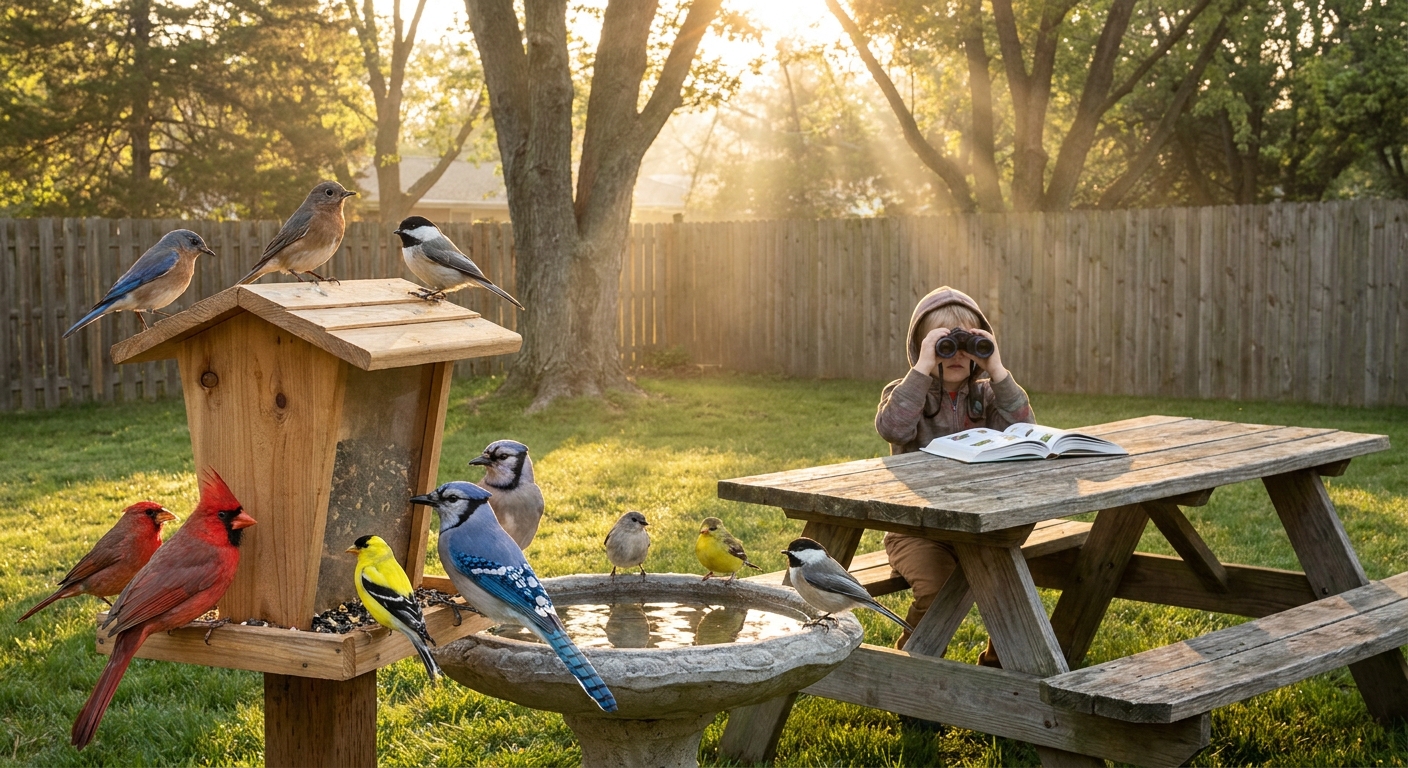
Walk outside with a mug of something warm and stand still for two minutes. Chances are, at least one bird is already watching you from a fencepost, shrub, or rooftop. These everyday companions are easy to overlook precisely because they’re common. Yet for a patient observer, backyard birds offer an endlessly changing field guide—one you can visit between errands, in slippers, or during lunch breaks.
Introduction
This guide introduces a "Backyard Big Ten": ten species many North American birdwatchers are likely to encounter around homes, parks, and small patches of green. You’ll find identification tips, seasonal context, behavior clues, and simple techniques to sharpen your skills.
1. Northern Cardinal: The Red Exclamation Point
ID snapshot
- Male: Vivid red overall, black face mask, prominent crest, thick orange-red bill.
- Female: Warm buff-brown with reddish wings, tail, and crest; blackish face; same thick bill.
- Size: About the length of a smartphone (8–9") but chunkier.
Field notes
Cardinals prefer shrubby edges and dense hedges. Look for them hopping low, using their heavy bills to crack seeds. At dawn and dusk, males sing loud, clear whistles from mid-height perches: “cheer, cheer, cheer… birdy-birdy-birdy.”
Observation tip: In winter, males often look brighter against snow. Use that contrast to watch how individual birds hold their crests—some keep them flattened, others perpetually raised like a tiny red flame.
2. American Robin: The Lawn Inspector
ID snapshot
- Gray-brown back, rich orange breast, yellow bill.
- White lower belly and undertail.
- Runs in short spurts on lawns, then pauses upright.
Seasonal context
Robins are often associated with spring, but in many regions they’re year-round. In winter they may switch from lawns to fruit-bearing trees, forming loose flocks.
Behavior clue: Watch the foraging pattern: run-stop-tilt. That head tilt is not for listening—it’s for using one eye to visually locate worms.
3. House Sparrow: The Sidewalk Regular
ID snapshot
- Small, stocky, with a thick seed-cracking bill.
- Male: Gray cap, chestnut nape, black bib, two pale wingbars.
- Female/immature: Plain buff-brown, subtle streaking, light eyebrow.
Habitat note
Strongly tied to human structures, often nesting in cracks, awnings, store signs, and vents. If you see a busy flock around a fast-food patio, you’re likely looking at House Sparrows.
Observation tip: Learn their chatter: a cascade of sharp “cheep” notes, often in a constant social buzz. Once your ear catches it, you’ll detect them before spotting them.
4. Black-capped (or Carolina) Chickadee: The Pocket-Sized Acrobat
ID snapshot
- Tiny, round-bodied.
- Black cap and throat, white cheeks.
- Soft gray back, buffy flanks.
Regional variation
In the northern U.S. and Canada, you’ll likely see Black-capped Chickadees; in the Southeast, Carolina Chickadees. They look very similar—focus instead on their presence and calls rather than perfect ID at first.
Field behavior
Chickadees travel in mixed flocks with nuthatches and woodpeckers during fall and winter. They move in quick bursts—hovering, hanging upside down from twigs, and investigating bark crevices.
Sound cue: The name-like “chick-a-dee-dee-dee” scold call is unmistakable. More ‘dees’ often signal higher alarm.
5. Downy Woodpecker: The Small Trunk Tapper
ID snapshot
- Small, black-and-white, with a checkered back and white belly.
- White stripe down the back; black-and-white striped head.
- Male: Small red patch on back of head.
- Short bill relative to head size (key for separating from Hairy Woodpecker).
Where to look
Scan tree trunks and thicker branches, especially near suet feeders. They often cling quietly, then give away their presence with a soft “pik” call or a short drum.
Technique tip: Use your ears. On a calm day, the tap-tap-tap of foraging woodpeckers carries surprisingly far. Follow the sound, then raise binoculars slowly.
6. Mourning Dove: The Suburban Ghost
ID snapshot
- Plump, sandy-brown dove with black spots on wings.
- Long, pointed tail edged in white seen in flight.
- Small head, soft dark eye.
Sound and flight
The low, mournful cooing often echoes in the early morning: “oo-oo-OO, oo, oo.” In flight, listen for a distinctive whistling of the wings—especially when flushed from the ground.
Backyard behavior: Common at ground-feeding stations, especially where seed spills beneath hanging feeders. Watch for careful, nodding walks and companionable pairs.
7. Blue Jay: The Neighborhood Sentry
ID snapshot
- Bright blue above, white below.
- Bold black necklace and facial markings.
- Crested head, patterned blue-and-black wings and tail.
Behavior clue
Blue Jays act like alarm systems. Notice when the yard suddenly explodes in their harsh “jay! jay!” calls—raptors may be nearby. They also mimic hawk screams, so listen for context and repetition.
Observation tip: Watch their caching behavior in fall: they quietly carry whole acorns or peanuts in their throat pouch and hide them in lawns and leaf litter, often one by one.
8. American Goldfinch: The Living Lemon Drop (Seasonal)
ID snapshot
- Breeding male: Brilliant yellow body, black cap, black wings with white wingbars.
- Female & winter birds: More muted olive or brownish-yellow, still with wingbars.
- Small, short conical bill.
Seasonal molt
Goldfinches undergo a dramatic molt; winter birds may look entirely different from their summer selves. Notice the gradual reappearance of brighter yellow in late spring.
Flight pattern: Watch for bouncy, undulating flight with a repeated “po-ta-to-chip” call.
9. House Finch: The Urban Songster
ID snapshot
- Small finch with streaky brown body.
- Male: Variable red wash on head, throat, and upper breast (sometimes orange or yellowish).
- Female: Brown and streaky with no red.
Vocal signature
Listen for a tumbling, bubbly song that sounds like a loose handful of notes spilled all at once. House Finches often sing from wires, roof peaks, or small trees.
Identification pitfall: Don’t confuse them with Purple Finches. House Finch males usually have more streaking on the sides and a thinner, more curved bill. In many backyards, House Finch is far more likely.
10. European Starling: The Iridescent Shape-shifter
ID snapshot
- Stocky, short tail, long slender bill.
- Glossy, dark appearance that flashes purple and green in strong light.
- Winter: Speckled with white spots.
Behavior and flocking
Famous for forming large swirling flocks (murmurations) at roost. In backyards, they can monopolize suet or fruit feeders.
Observation reward: Instead of dismissing them as plain black birds, look closely in good light: note the sheen, the changing speckling, and the color of the bill shifting from dark in winter to yellow in breeding season.
Gear and Techniques for Backyard Birding
1. Optics: Binoculars and Beyond
- Binoculars: An 8×42 or 8×32 pair offers a wide field of view and enough light for dawn/dusk. If your backyard is small, even compact 8×25 models can suffice.
- Positioning: Keep binoculars within arm’s reach near a window. Regular use beats premium glass that stays in a closet.
2. Field Guides and Apps
- Printed guide: Choose one with clear range maps and multiple plumage illustrations per species (male, female, juvenile, seasonal).
- Digital apps: Helpful for quick ID checks and comparing similar species. Use sound libraries to match calls, but always with caution; birds sometimes react strongly to excessive playback.
3. A Simple Observation Routine
Try a short, consistent "yard survey":
- Time: Ten minutes, same time each day or a few times per week.
- Method: Stand or sit in one spot. Note every species you see or hear.
- Focus: Pick one species and pay attention solely to its behavior—feeding heights, preferred perches, interactions.
Over a month, patterns emerge: who appears only at dawn, who prefers the neighbor’s tree, who vanishes in midsummer.
Seasonal Shifts in Your Backyard
- Spring: Watch for migrants dropping into even tiny yards—warblers, kinglets, and sparrows refueling in budding trees. Pay attention to brief, one- or two-day visitors.
- Summer: Nesting season. Observe from a respectful distance; look for adults carrying food or disappearing into dense shrubs.
- Fall: Flocks grow, juveniles appear at feeders, and mixed-species feeding groups roam. Listen for subtle contact calls.
- Winter: Fewer species, but clearer patterns. A dependable group of regulars can teach you nuance: subtle plumage wear, dominance at feeders, and individual quirks.
Turning Familiar Birds into Fascinating Subjects
Backyard birding is not about chasing rarities—it’s about learning to see. The same robin you’ve walked past for years becomes a study in foraging strategies. The cardinal pair reveals a calendar of plumage wear, nesting attempts, and territorial songs.
Keep a small notebook or a digital log. Note specific behaviors: a Blue Jay hiding three peanuts in different spots, a chickadee inspecting the same branch knot every day, a Mourning Dove that always chooses the left side of the feeder tray.
The more attention you give your Backyard Big Ten, the more you’ll notice that "common" birds are anything but ordinary.